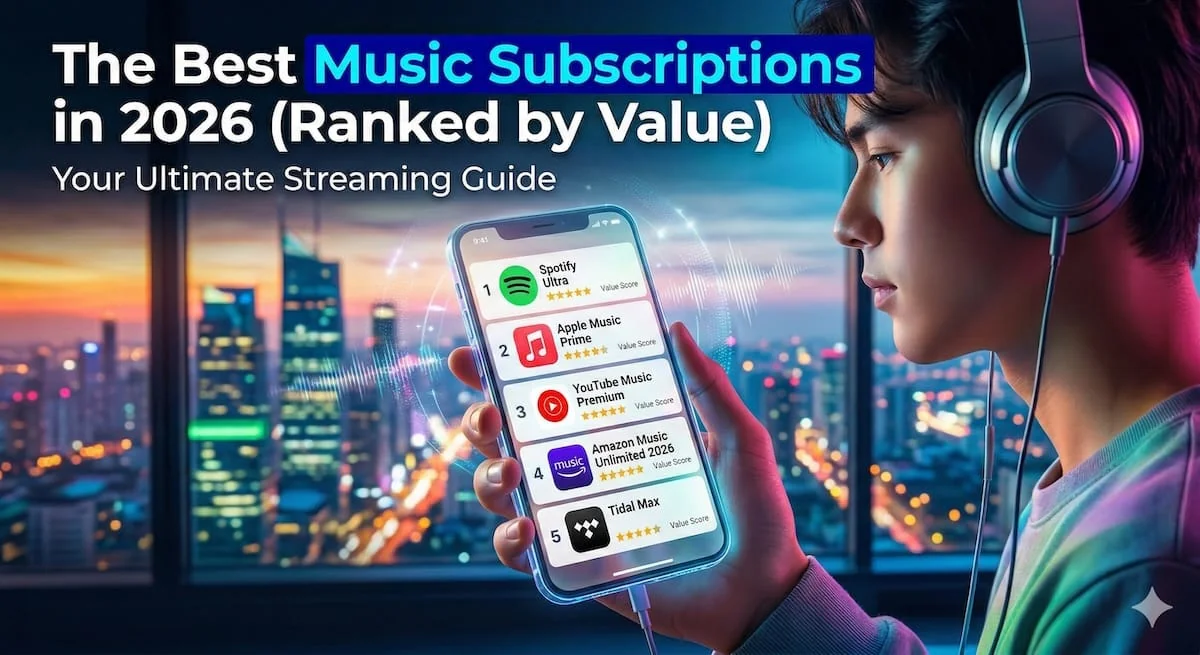
De bästa musikabonnemangen 2026 (rankade efter värde)
Quick Summary
Säkraste valet: Spotify. Om du tittar på YouTube dagligen ersätter YouTube Premium annoncer och ger dig musik i en räkning. Om du bara vill lyssna på musik är YouTube Music billigare än Premium. Apple Music är det uppenbara valet om ditt helt hushål använder Apple. För ljudkvalitetsuppgraderingar, Tidal eller Qobuz — men kontrollera tillgängligheten i din region först. Oavsett vilken tjänst du väljer, kontrollera vad den kostar i andra länder innan du betalar fullt pris.
Snabb jämförelse: bäst för
| Service | Best for | Why people pick it |
|---|---|---|
| Spotify | All-around | Best discovery algorithms, widest device support, podcasts included |
| YouTube Premium | YouTube-heavy users | Ad-free YouTube + background play + full YouTube Music access |
| YouTube Music | Google ecosystem | Music-focused option, included free with Premium |
| Apple Music | Apple devices | Deep integration with iPhone, HomePod, Apple Watch, Siri |
| Tidal | Hi-fi mainstream | Lossless and Dolby Atmos across a mainstream catalog |
| Deezer | Underrated alternative | Strong catalog, Flow AI discovery, available in 180+ countries |
| Qobuz | Audiophiles | Studio-quality hi-res purchases and streaming |
| SoundCloud Go | Indie & underground | Largest independent artist catalog, remix culture |
Prissättning verifiering: samma tjänst kostar olika belopp beroende på var du är
Det här är något de flesta inte tänker på förrän de ser siffrorna. Den exakta Spotify Premium-planen kan kosta $1,58/månad i ett land och $10,99/månad i ett annat. Samma katalog, samma funktioner — bara en annan prissättning baserat på där du registrerar dig.
Jag har spårat regional prissättning för musikjänster över 180+ länder, och skillnaderna är massiva. Vi talar om 50–80% billigare i många fall. Innan du åtar dig någon årsplan är det värt att spendera två minuter på våra jämförelse sidor för att se vad samma prenumeration kostar någon annanstans. Jag kommer inte att citera specifika priser här eftersom de ändras regelbundet — jämföringstabellerna på varje tjänstsida är alltid aktuella.
Rankingarna: vilken musikjänst bör du faktiskt välja?
Jag har testat alla dessa tjänster personligen — några i flera år, andra granskar jag var par månader för att se vad som har ändrats. Här är mitt ärliga svar på var och en 2026.
1. Spotify — bäst för allt
Det finns en anledning till att Spotify har fler betalande prenumeranter än någon annan. Rekommendationsmotorn är fortfarande den bästa i branschen — Discover Weekly och Daily Mix framhäver konsekvent spår jag faktiskt vill höra, inte bara vad skivbolaget pushear den veckan. Appen fungerar bra på praktiskt taget allt: telefoner, datorer, smarta högtalare, spelkonsoler, bilsystem. Det bara fungerar.
Den kostnadsfria nivån är genuint användbar om du kan tolerera annonser, vilket gör det ett bra sätt att testa innan du åtar dig. På den betalda sidan har Spotify äntligen lanserat förlustfritt ljud i sen 2024 efter års löfte, så ljudkvalitetsklyft med Tidal har minskat betydligt. Podcasts och audioböcker är inbakade i samma app, vilket antingen är bekvämt eller irriterande beroende på hur du känner för podcastrekommendationer som kryddar din hemskärm.
Det största problemet med Spotify är att det betalar artister dåligt — den lägsta per-stream-takten för någon större plattform. Om att stödja musiker direkt spelar roll för dig är det värt att veta. Men för ren lyssnarvärde är det svårt att slå.

Spotify
184 countries compared

Cheapest
Nigeria
$1.16/mo

Most expensive
Liechtenstein
$19.73/mo
2. YouTube Premium — bäst om YouTube redan är din dagliga vana
Det här är prenumerationen jag rekommenderar oftast till människor som säger mig att de tittar på YouTube varje dag. Presentationen är enkel: du betalar för annonsfritt YouTube (vilket ensamt sparar dig timmar av ditt liv per månad), bakgrundsspelning på mobil, och du får YouTube Music inkluderad utan extra kostnad. För många människor eliminerar det behovet av en separat musikprenumeration helt.
YouTube Music själv är anständig — inte spektakulär. Katalogen är massiv eftersom den inkluderar officiella utgåvor plus hela YouTube-ekosystemet av liveframträdanden, remixer, omlagningar och fanuploads som du inte kommer att hitta någon annanstans. Rekommendationerna blir bättre men ligger fortfarande efter Spotifys. Där det blir intressant är den regionala prissättningen: YouTube Premium är tillgänglig i 110+ länder med några av de största prisgapen jag har spårat. I vissa marknader betalar du en bråkdel av vad det kostar i USA eller Europa.
Nackdelen: om du inte tittar på YouTube regelbundet betalar du en premie för videosidan och får inte mycket värde från det. I det fallet är en fristående musikjänst mer meningsfull.

YouTube Premium
111 countries compared

Cheapest
India
$0.93/mo

Most expensive
United Kingdom
$10.69/mo
3. YouTube Music — bäst om du bara vill ha musik (utan videoperkorna)
YouTube Music förtjänar sin egen plats på listan eftersom den löser ett specifikt problem: du vill ha YouTubes musikkatalog — inklusive liveframträdandena, omlagningarna och remixerna som ingen annan plattform har — men du tittar inte på YouTube-videor tillräckligt ofta för att motivera att betala för den fullständiga Premium-prenumerationen.
Vid $10,99/månad för enskild i USA är YouTube Music billigare än YouTube Premium ($13,99) och konkurrenskraftigt prissatt mot Spotify ($12,99) och Apple Music ($10,99). Studentplanen vid $5,49 är ett av de billigaste studentalternativen över alla musikjänster. Familjeplan vid $16,99/månad för upp till fem medlemmar är också solid värde — billigare än Spotify Family ($21,99) och Apple Music Family ($16,99 för sex medlemmar).
Den unika fördelen: YouTube Music hämtar från hela YouTube-ekosystemet. Det betyder att du får tillgång till livekoncertinspelningar, sällsynta akustiska sessioner, fanskapade remixer och musikvideor tillsammans med standardalbumspår — allt i en app. Om du någonsin sökt efter en specifik liveversion av en låt på Spotify och kommit upp tom, YouTube Music har nästan säkert det.
Nackdelarna är verkliga dock. Rekommendationsalgoritmen är märkbart svagare än Spotifys — den tenderar att loopa dig tillbaka till vad du redan har lyssnat på snarare än att pressa dig mot nya artister. Appens gränssnitt kan kännas rörig, blandning av musikvideor med endast-ljud-spår på sätt som ibland är förvirrande. Och det finns knappt sociala funktioner — ingen samarbetsplaylister, ingen gemensam lyssningssession, ingen motsvarighet till Spotify Wrapped.
Min uppfattning: om du redan betalar för YouTube Premium får du YouTube Music inkluderad — det finns ingen anledning att överväga det separat. Men om du inte bryr dig om annonsfri YouTube-video och bara vill ha en musikapp med det djupaste katalogen av live- och inofficiella innehål, är YouTube Music standalone ett övertygande val till ett rättvist pris. Det är tillgängligt i 111 länder med betydande regional prisvariation.

YouTube Music Premium
111 countries compared
Cheapest
Nigeria
$0.95/mo

Most expensive
Switzerland
$17.19/mo
Där Apple Music faller kort: Android-appen finns men det är helt klart inte prioritet. Sociala funktioner är minimala. Och om du inte redan är i Apple-ekosystemet finns det ingen övertygande anledning att börja här framför Spotify. Familjeplan är dock konkurrenskraftig — sex konton under en prenumeration fungerar väl för Apple-hushåll.
If your household runs on Apple — iPhones, iPads, Macs, HomePods, Apple Watch — then Apple Music is the path of least resistance. The integration is seamless in a way that third-party apps can't quite match: Siri controls work reliably, spatial audio with Dolby Atmos sounds genuinely impressive on AirPods Pro, and the Apple Watch app lets you stream without your phone nearby.
Apple Musics katalog är jämförbar med Spotifys på 100+ miljoner låtar, och förlustfri ljud har inkluderats utan extra kostnad sedan 2021 — något Spotify tog tre år till för att matcha. De redaktionella spellistorna är utvalda av faktiska människor snarare än algoritmer, vilket ger dem en annan karaktär. Vissa föredrar det; personligen tycker jag att Spotifys algoritmiska tillvägagångssätt fångar min smak bättre, men det är subjektivt.
Where Apple Music falls short: the Android app exists but it's clearly not the priority. The social features are minimal. And if you're not already in the Apple ecosystem, there's no compelling reason to start here over Spotify. The Family plan is competitive, though — six accounts under one subscription works well for Apple households.

Apple Music
113 countries compared
Cheapest
India
$1.25/mo

Most expensive
Kuwait
$17.75/mo
5. Tidal — best for sound quality without the audiophile gatekeeping
Tidal has been the go-to recommendation for better audio quality for years, and it's earned that reputation. Lossless FLAC, Dolby Atmos mixes, and Sony 360 Reality Audio are all available depending on your plan. The difference between Tidal HiFi and a standard-quality stream on most services is audible if you have decent headphones — not night-and-day, but noticeable on tracks with complex production.
Beyond audio quality, Tidal has quietly built a reputation for paying artists the most per stream of any major platform. If that matters to you ethically, it's a real differentiator. The catalog is solid at 100+ million tracks, and Tidal Connect lets you push audio to compatible devices (similar to Spotify Connect). The recommendation engine has improved a lot over the past year but still isn't at Spotify's level.
Fångsten: Tidal är inte tillgängligt överallt. Om du är i ett land där det fungerar är det ett starkt alternativ. Om inte är Qobuz eller Deezers HiFi-nivå alternativ värda att överväga.

Tidal
61 countries compared

Cheapest
Argentina
$0.25/mo
Most expensive
Liechtenstein
$17.25/mo
Qobuz är en nischservice och det vet det. Detta är för personer som äger DAC:er, har åsikter om bitdjup och kan se skillnad mellan 16-bitars och 24-bitars ljud. Om det är du, levererar Qobuz: studiokvalitetsströmmning upp till 24-bit/192kHz, plus möjligheten att köpa och ladda ned hi-res-spår permanent — något som de flesta streamingtjänster inte erbjuder.
Deezer is the music service that everyone forgets about, and I genuinely think that's unfair. It has a catalog of 100+ million tracks, it's available in 180+ countries (more than Spotify), and its Flow feature — an AI-powered personal radio that learns your taste — is one of the better discovery tools I've used. It's like a smarter version of a radio station that actually gets what you want to hear.
The app is clean and responsive, the lyrics integration works well, and Deezer HiFi offers lossless FLAC streaming for people who care about audio quality. The pricing is competitive with Spotify in most markets, and in some regions it's noticeably cheaper. The free tier is ad-supported and functional, though more limited than Spotify's free version.
Where Deezer struggles: the social and sharing features are underdeveloped compared to Spotify, and the third-party integrations (smart speakers, car systems) have gaps. If you're embedded in Spotify's social ecosystem — shared playlists, Wrapped, collaborative listening — switching to Deezer will feel like a step backward in that specific area. But for pure listening? It's genuinely good.

Deezer
158 countries compared

Cheapest
Turkey
$1.28/mo
Most expensive
Switzerland
$18.49/mo
7. Qobuz — för seriösa audiofialer
Qobuz is a niche service and it knows it. This is for people who own DACs, have opinions about bit depth, and can tell the difference between 16-bit and 24-bit audio. If that's you, Qobuz delivers: studio-quality streaming up to 24-bit/192kHz, plus the ability to purchase and download hi-res tracks permanently — something most streaming services don't offer.
The catalog is smaller than the big players at around 100 million tracks, with a strong lean toward classical, jazz, and indie. Pop and hip-hop coverage is solid but you might occasionally find gaps in regional or very niche genres. The app is functional but no-frills — this is not a service you pick for its UI design or social features.
The biggest limitation is availability. Qobuz operates in around 20 countries — mostly Western Europe, the US, and a handful of others. If it's not available where you are, Tidal HiFi is the closest mainstream alternative. And the pricing reflects the premium positioning: it's the most expensive option on this list in most markets.

Qobuz
19 countries compared

Cheapest
Brazil
$5.02/mo

Most expensive
Denmark
$22.93/mo
8. SoundCloud Go — best for independent and underground music
SoundCloud tar en unik plats på denna lista eftersom det är den enda plattformen där oberoende artister kan ladda upp direkt utan en distributör. Det betyder att du hittar spår, remixar, DJ-set och outsläppt material här som helt enkelt inte finns på Spotify eller Apple Music. För fans av elektronisk musik, hip-hop, lo-fi och experimentella genrer är SoundCloud oersättligt.
SoundCloud Go (the paid tier) removes ads and unlocks offline listening, while Go+ adds the full major-label catalog on top of the independent content. The recommendation algorithm is decent for surfacing underground artists, though it can feel chaotic compared to Spotify's more polished suggestions. The app works fine but isn't winning any design awards.
I wouldn't recommend SoundCloud as your only music subscription — the mainstream catalog on Go+ still has gaps. But as a secondary subscription for discovery and independent music? Nothing else comes close.

SoundCloud Go
29 countries compared

Cheapest
Mexico
$3.36/mo
Most expensive
Denmark
$9.02/mo

Save on your subscription with a VPN
Regional pricing means the same subscription can cost significantly less in another country. Use CometVPN to connect to the cheapest region and sign up at the lowest price — safely and securely.
Try CometVPNHow to pick: the decision tree I actually use
After years of testing and comparing these services, I've boiled the decision down to a few honest questions:
- Tittar du på YouTube varje dag? → Skaffa YouTube Premium. Du dödar två prenumerationer med en räkning och sparar pengar i längden.
- Lyssnar du bara på musik och bryr dig inte om annonserad YouTube-video? → YouTube Music standalone för $10,99/månad ger dig det djupaste katalogen med live- och inofficiellt innehål till ett konkurrenskraftigt pris.
- Är ditt hushåll helt in på Apple (iPhones, HomePods, Apple Watch)? → Apple Music integreras bättre än något annat i det ekosystemet.
- Bryr du dig om ljudkvalitet och äger anständiga hörlurar eller högtalare? → Tidal om du vill ha en mainstream-upplevelse, Qobuz om du är en riktig audiofil.
- Vill du ha den största upptäcktningsmotorn och bredaste enhetsstöd? → Spotify. Det är standardrekommendationen av en anledning.
- Befinner du dig på en marknad där Deezer är billigare än Spotify? → Ge Deezer ett seriöst försök. Flow-funktionen själv kan konvertera dig.
- Lyssnar du mycket på oberoende, underjordiskt eller remixinnehål? → Behåll SoundCloud Go som ett sekundärt abonnemang.
One more thing: always check regional pricing
I can't stress this enough. The same music subscription can cost 3–5x more depending on your country. I built SubscriptionsCompare specifically because I kept finding these price gaps and thought everyone should have easy access to this data. Before you sign up for anything, spend 30 seconds checking what it costs in other regions — you might save 50–80% on the exact same service.
Compare all music subscriptions by country: SubscriptionsCompare.com/compare
FAQ
Är en familjeplan värd det för musikabonnemang?
Nästan alltid, om du har 2 eller fler lyssnare i hushållet. Familjeplanerna täcker vanligtvis 5–6 konton för ungefär priset för 2 individuella abonnemang. Matematiken går snabbt ut. Se bara till att alla i planen faktiskt kommer att använda den — oanvända platser är slösat pengar.
Är YouTube Music detsamma som YouTube Premium?
Nej. YouTube Music är en standalone musikapp (gratis med annonser, eller betald för annonsfri). YouTube Premium inkluderar YouTube Music automatiskt, plus annonsfri YouTube-video, bakgrundsuppspelning och bild-i-bild på mobil. Om du bestämmer dig mellan de två är Premium vanligtvis det bättre valet eftersom du får båda.
Kan jag faktiskt höra skillnaden med förlustfri ljud?
Det beror på din inställning. Med vanliga öronsnäckor eller bärbara högtalarare förmodligen inte. Med bra över-örat hörlurar, bra IEM:er eller ett korrekt högtalaruppställning kan de flesta höra skillnaden — särskilt på spår med komplex instrumentering, brett dynamiskt område eller detaljerad produktion. Prova en gratis trial av Tidal HiFi med din egen utrustning innan du förbinder dig.
Vilken musiktjänst betalar artister mest?
Tidal betalar konsekvent den högsta per-stream-takten bland större plattformar, följt av Apple Music. Spotify betalar minst per stream, även om det hävdar att dess större användarbase kompenserar för den lägre takten. Om det spelar roll att finansiellt stödja artister är detta värt att ta in i ditt beslut.
Kan jag använda en VPN för att få billigare musikabonnemang?
Ja — musiktjänster använder regional prissättning, och att ansluta genom en VPN-server i ett billigare land låter dig registrera dig till den lokala takten. Kontrollera våra jämförelsesidor för att hitta det billigaste landet för någon tjänst, använd sedan en VPN som CometVPN för att få tillgång till den prissättningen.
Vad sägs om studentrabatter?
Spotify, Apple Music, Deezer och Tidal erbjuder alla studentplaner på ungefär 50% rabatt på standardindividualpriset. Du måste verifiera din inskrivning genom en studentverifieringstjänst. Dessa rabatter staplas med regional prissättning i vissa fall, vilket gör studentplaner i billigare länder extremt överkomliga.
Är det värt att ha två musikabonnemang?
För de flesta nej — en tjänst täcker 95% av vad du behöver. Undantaget är om du lyssnar mycket på oberoende eller underjordisk musik på SoundCloud som inte är tillgänglig på annat håll. I så fall är ett primärt abonnemang (Spotify, Apple Music, etc.) plus SoundCloud Go vettigt.
Hur ofta ändras musikkryppriser?
Oftare än du kan tro. Spotify och Apple Music höjde båda priserna 2023–2024, och de flesta tjänster justerar regional prissättning kvartalsvis baserat på växelkurser och marknadsförhållanden. Det är därför vi uppdaterar våra prisdata regelbundet — vad som var billigast för sex månader sedan kanske inte är billigast idag.
Gör Dolby Atmos-musik faktiskt någon skillnad?
På stödda hörlurar (som AirPods Pro) eller en korrekt surroundljuduppställning kan Atmos-mixar låta märkbart mer rymmlig och omslutande — särskilt på spår som specifikt var mixade för rumslig ljud. På vanliga stereohörlurar är effekten subtil i bästa fall. Apple Music och Tidal erbjuder båda Atmos-innehål; Spotify har varit långsamt att anta det.
Vilken tjänst har den bästa offline-nedladdningsupplevelsen?
Spotify och Apple Music är båda utmärkta för offline-lyssning — smidig nedladdningshantering, automatisk synkronisering av spellistor och pålitlig uppspelning utan anslutning. YouTube Music fungerar bra men laddar ibland ned spår onödigt. Deezer och Tidal är solida. Qobuz låter dig ladda ned hi-res-filer, men de äter lagringsutrymme snabbt.