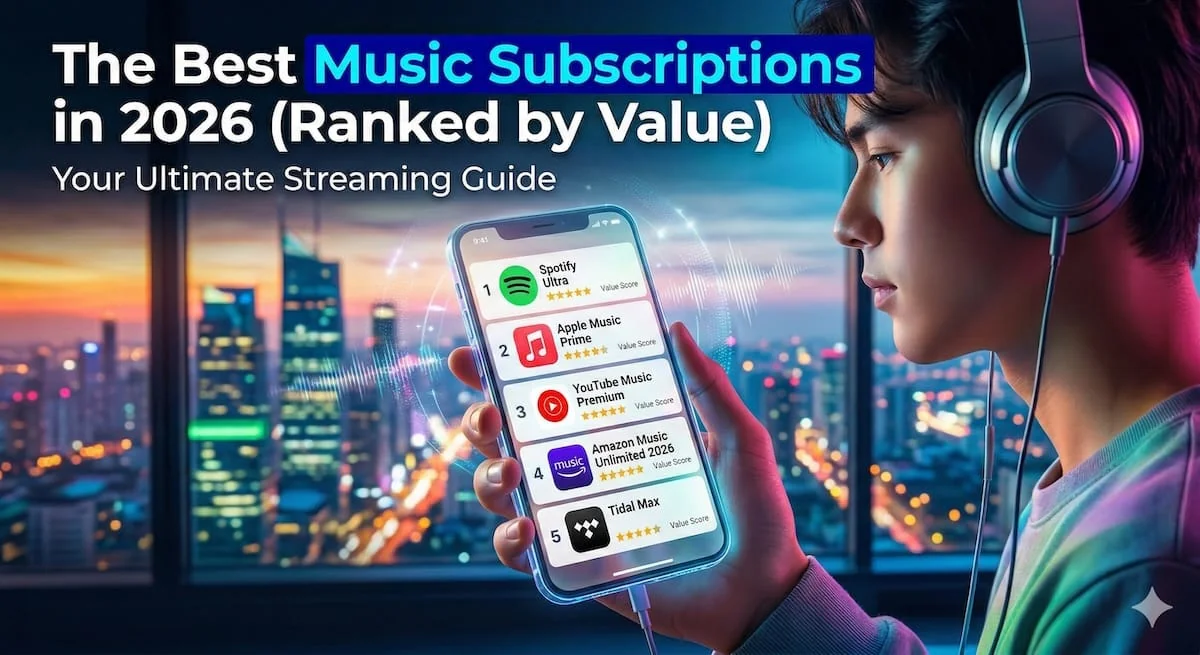
The Best Music Subscriptions in 2026 (Ranked by Value)
Quick Summary
Safest all-around pick: Spotify. If you watch YouTube daily, YouTube Premium replaces ads and gives you music in one bill. If you only listen to music, YouTube Music is cheaper than Premium. Apple Music is the obvious choice if your whole household runs Apple. For sound-quality upgrades, Tidal or Qobuz — but check availability in your region first. And no matter which service you pick, check what it costs in other countries before paying full price.
Quick comparison: best for
| Service | Best for | Why people pick it |
|---|---|---|
| Spotify | All-around | Best discovery algorithms, widest device support, podcasts included |
| YouTube Premium | YouTube-heavy users | Ad-free YouTube + background play + full YouTube Music access |
| YouTube Music | Google ecosystem | Music-focused option, included free with Premium |
| Apple Music | Apple devices | Deep integration with iPhone, HomePod, Apple Watch, Siri |
| Tidal | Hi-fi mainstream | Lossless and Dolby Atmos across a mainstream catalog |
| Deezer | Underrated alternative | Strong catalog, Flow AI discovery, available in 180+ countries |
| Qobuz | Audiophiles | Studio-quality hi-res purchases and streaming |
| SoundCloud Go | Indie & underground | Largest independent artist catalog, remix culture |
Pricing reality check: the same service costs different amounts depending on where you are
This is something most people don't think about until they see the numbers. The exact same Spotify Premium plan can cost $1.58/month in one country and $10.99/month in another. Same catalog, same features — just a different price tag based on where you sign up.
I've been tracking regional pricing for music services across 180+ countries, and the differences are massive. We're talking 50–80% cheaper in many cases. Before you commit to any annual plan, it's worth spending two minutes on our comparison pages to see what the same subscription costs elsewhere. I'm not going to quote specific prices here because they change regularly — the comparison tables on each service page are always current.
The rankings: which music service should you actually pick?
I've tested all of these services personally — some for years, others I revisit every few months to see what's changed. Here's my honest take on each one in 2026.
1. Spotify — best all-around
There's a reason Spotify has more paying subscribers than anyone else. The recommendation engine is still the best in the business — Discover Weekly and Daily Mix consistently surface tracks I actually want to hear, not just whatever the label is pushing that week. The app works well on basically everything: phones, desktops, smart speakers, game consoles, car systems. It just works.
The free tier is genuinely usable if you can tolerate ads, which makes it a good way to test before committing. On the paid side, Spotify finally rolled out lossless audio in late 2024 after years of promising it, so the sound quality gap with Tidal has narrowed significantly. Podcasts and audiobooks are baked into the same app, which is either convenient or annoying depending on how you feel about podcast recommendations cluttering your home screen.
The biggest knock on Spotify is that it pays artists poorly — the lowest per-stream rate of any major platform. If supporting musicians directly matters to you, that's worth knowing. But for pure listener value, it's hard to beat.

Spotify
184 countries compared

Cheapest
Nigeria
$1.16/mo

Most expensive
Liechtenstein
$19.73/mo
2. YouTube Premium — best if YouTube is already your daily habit
This is the subscription I recommend most often to people who tell me they watch YouTube every day. The pitch is simple: you're paying for ad-free YouTube (which alone saves you hours of your life per month), background play on mobile, and you get YouTube Music included at no extra cost. For a lot of people, that eliminates the need for a separate music subscription entirely.
YouTube Music itself is decent — not spectacular. The catalog is huge because it includes official releases plus the entire YouTube ecosystem of live performances, remixes, covers, and fan uploads that you won't find anywhere else. The recommendations are getting better but still lag behind Spotify's. Where it gets interesting is the regional pricing: YouTube Premium is available in 110+ countries with some of the widest price gaps I've tracked. In some markets, you're paying a fraction of what it costs in the US or Europe.
The downside: if you don't watch YouTube regularly, you're paying a premium for the video side and not getting much value from it. In that case, a standalone music service makes more sense.

YouTube Premium
111 countries compared

Cheapest
India
$0.93/mo

Most expensive
United Kingdom
$10.69/mo
3. YouTube Music — best if you only want music (without the video perks)
YouTube Music deserves its own spot on this list because it solves a specific problem: you want YouTube's music catalog — including the live performances, covers, and remixes that no other platform has — but you do not watch YouTube videos enough to justify paying for the full Premium subscription.
At $10.99/month for Individual in the US, YouTube Music is cheaper than YouTube Premium ($13.99) and competitively priced against Spotify ($12.99) and Apple Music ($10.99). The Student plan at $5.49 is one of the cheapest student options across all music services. The Family plan at $16.99/month for up to five members is also solid value — cheaper than Spotify Family ($21.99) and Apple Music Family ($16.99 for six members).
The unique advantage: YouTube Music pulls from the entire YouTube ecosystem. That means you get access to live concert recordings, rare acoustic sessions, fan-made remixes, and music videos alongside standard album tracks — all in one app. If you have ever searched for a specific live version of a song on Spotify and come up empty, YouTube Music almost certainly has it.
The downsides are real, though. The recommendation algorithm is noticeably weaker than Spotify's — it tends to loop you back to what you have already listened to rather than pushing you toward new artists. The app interface can feel cluttered, mixing music videos with audio-only tracks in ways that are sometimes confusing. And there are no social features to speak of — no collaborative playlists, no shared listening sessions, no equivalent of Spotify Wrapped.
My take: if you are already paying for YouTube Premium, you get YouTube Music included — there is no reason to consider it separately. But if you do not care about ad-free YouTube video and just want a music app with the deepest catalog of live and unofficial content, YouTube Music standalone is a compelling choice at a fair price. It is available in 111 countries with significant regional pricing variation.

YouTube Music Premium
111 countries compared
Cheapest
Nigeria
$0.95/mo

Most expensive
Switzerland
$17.19/mo
4. Apple Music — best for Apple households
If your household runs on Apple — iPhones, iPads, Macs, HomePods, Apple Watch — then Apple Music is the path of least resistance. The integration is seamless in a way that third-party apps can't quite match: Siri controls work reliably, spatial audio with Dolby Atmos sounds genuinely impressive on AirPods Pro, and the Apple Watch app lets you stream without your phone nearby.
Apple Music's catalog is comparable to Spotify's at 100+ million tracks, and lossless audio has been included at no extra cost since 2021 — something Spotify took three more years to match. The editorial playlists are curated by actual humans rather than algorithms, which gives them a different character. Some people prefer that; I personally find Spotify's algorithmic approach catches my taste better, but it's subjective.
Where Apple Music falls short: the Android app exists but it's clearly not the priority. The social features are minimal. And if you're not already in the Apple ecosystem, there's no compelling reason to start here over Spotify. The Family plan is competitive, though — six accounts under one subscription works well for Apple households.

Apple Music
113 countries compared
Cheapest
India
$1.25/mo

Most expensive
Kuwait
$17.75/mo
5. Tidal — best for sound quality without the audiophile gatekeeping
Tidal has been the go-to recommendation for better audio quality for years, and it's earned that reputation. Lossless FLAC, Dolby Atmos mixes, and Sony 360 Reality Audio are all available depending on your plan. The difference between Tidal HiFi and a standard-quality stream on most services is audible if you have decent headphones — not night-and-day, but noticeable on tracks with complex production.
Beyond audio quality, Tidal has quietly built a reputation for paying artists the most per stream of any major platform. If that matters to you ethically, it's a real differentiator. The catalog is solid at 100+ million tracks, and Tidal Connect lets you push audio to compatible devices (similar to Spotify Connect). The recommendation engine has improved a lot over the past year but still isn't at Spotify's level.
The catch: Tidal isn't available everywhere. If you're in a country where it operates, it's a strong option. If not, Qobuz or Deezer's HiFi tier are alternatives worth considering.

Tidal
61 countries compared

Cheapest
Argentina
$0.25/mo
Most expensive
Liechtenstein
$17.25/mo
6. Deezer — the underrated pick that deserves more attention
Deezer is the music service that everyone forgets about, and I genuinely think that's unfair. It has a catalog of 100+ million tracks, it's available in 180+ countries (more than Spotify), and its Flow feature — an AI-powered personal radio that learns your taste — is one of the better discovery tools I've used. It's like a smarter version of a radio station that actually gets what you want to hear.
The app is clean and responsive, the lyrics integration works well, and Deezer HiFi offers lossless FLAC streaming for people who care about audio quality. The pricing is competitive with Spotify in most markets, and in some regions it's noticeably cheaper. The free tier is ad-supported and functional, though more limited than Spotify's free version.
Where Deezer struggles: the social and sharing features are underdeveloped compared to Spotify, and the third-party integrations (smart speakers, car systems) have gaps. If you're embedded in Spotify's social ecosystem — shared playlists, Wrapped, collaborative listening — switching to Deezer will feel like a step backward in that specific area. But for pure listening? It's genuinely good.

Deezer
158 countries compared

Cheapest
Turkey
$1.28/mo
Most expensive
Switzerland
$18.49/mo
7. Qobuz — for the serious audiophiles
Qobuz is a niche service and it knows it. This is for people who own DACs, have opinions about bit depth, and can tell the difference between 16-bit and 24-bit audio. If that's you, Qobuz delivers: studio-quality streaming up to 24-bit/192kHz, plus the ability to purchase and download hi-res tracks permanently — something most streaming services don't offer.
The catalog is smaller than the big players at around 100 million tracks, with a strong lean toward classical, jazz, and indie. Pop and hip-hop coverage is solid but you might occasionally find gaps in regional or very niche genres. The app is functional but no-frills — this is not a service you pick for its UI design or social features.
The biggest limitation is availability. Qobuz operates in around 20 countries — mostly Western Europe, the US, and a handful of others. If it's not available where you are, Tidal HiFi is the closest mainstream alternative. And the pricing reflects the premium positioning: it's the most expensive option on this list in most markets.

Qobuz
19 countries compared

Cheapest
Brazil
$5.02/mo

Most expensive
Denmark
$22.93/mo
8. SoundCloud Go — best for independent and underground music
SoundCloud occupies a unique spot in this list because it's the only platform where independent artists can upload directly without a distributor. That means you'll find tracks, remixes, DJ sets, and unreleased material here that simply don't exist on Spotify or Apple Music. For fans of electronic music, hip-hop, lo-fi, and experimental genres, SoundCloud is irreplaceable.
SoundCloud Go (the paid tier) removes ads and unlocks offline listening, while Go+ adds the full major-label catalog on top of the independent content. The recommendation algorithm is decent for surfacing underground artists, though it can feel chaotic compared to Spotify's more polished suggestions. The app works fine but isn't winning any design awards.
I wouldn't recommend SoundCloud as your only music subscription — the mainstream catalog on Go+ still has gaps. But as a secondary subscription for discovery and independent music? Nothing else comes close.

SoundCloud Go
29 countries compared

Cheapest
Mexico
$3.36/mo
Most expensive
Denmark
$9.02/mo

Save on your subscription with a VPN
Regional pricing means the same subscription can cost significantly less in another country. Use CometVPN to connect to the cheapest region and sign up at the lowest price — safely and securely.
Try CometVPNHow to pick: the decision tree I actually use
After years of testing and comparing these services, I've boiled the decision down to a few honest questions:
- Do you watch YouTube every single day? → Get YouTube Premium. You're killing two subscriptions with one bill and saving money in the long run.
- Do you only listen to music and don't care about ad-free YouTube video? → YouTube Music standalone at $10.99/month gives you the deepest catalog of live and unofficial content at a competitive price.
- Is your household all-in on Apple (iPhones, HomePods, Apple Watch)? → Apple Music integrates better than anything else in that ecosystem.
- Do you care about audio quality and own decent headphones or speakers? → Tidal if you want a mainstream experience, Qobuz if you're a proper audiophile.
- Do you want the largest discovery engine and broadest device support? → Spotify. It's the default recommendation for a reason.
- Are you in a market where Deezer is cheaper than Spotify? → Give Deezer a serious try. The Flow feature alone might convert you.
- Do you listen to a lot of independent, underground, or remix content? → Keep SoundCloud Go as a secondary subscription.
One more thing: always check regional pricing
I can't stress this enough. The same music subscription can cost 3–5x more depending on your country. I built SubscriptionsCompare specifically because I kept finding these price gaps and thought everyone should have easy access to this data. Before you sign up for anything, spend 30 seconds checking what it costs in other regions — you might save 50–80% on the exact same service.
Compare all music subscriptions by country: SubscriptionsCompare.com/compare
FAQ
Is a family plan worth it for music subscriptions?
Almost always, if you have 2 or more listeners in your household. Family plans typically cover 5–6 accounts for roughly the price of 2 individual subscriptions. The math works out quickly. Just make sure everyone in the plan will actually use it — unused seats are wasted money.
Is YouTube Music the same as YouTube Premium?
No. YouTube Music is a standalone music app (free with ads, or paid for ad-free). YouTube Premium includes YouTube Music automatically, plus ad-free YouTube video, background play, and picture-in-picture on mobile. If you're deciding between the two, Premium is usually the better deal because you get both.
Can I actually hear the difference with lossless audio?
It depends on your setup. With standard earbuds or laptop speakers, probably not. With decent over-ear headphones, good IEMs, or a proper speaker setup, most people can hear the difference — especially on tracks with complex instrumentation, wide dynamic range, or detailed production. Try a free trial of Tidal HiFi with your own gear before committing.
Which music service pays artists the most?
Tidal consistently pays the highest per-stream rate among major platforms, followed by Apple Music. Spotify pays the least per stream, though it argues its larger user base compensates for the lower rate. If supporting artists financially matters to you, this is worth factoring into your decision.
Can I use a VPN to get cheaper music subscriptions?
Yes — music services use regional pricing, and connecting through a VPN server in a cheaper country lets you sign up at that local rate. Check our comparison pages to find the cheapest country for any service, then use a VPN like CometVPN to access that pricing.
What about student discounts?
Spotify, Apple Music, Deezer, and Tidal all offer student plans at roughly 50% off the standard individual price. You'll need to verify your enrollment through a student verification service. These discounts stack with regional pricing in some cases, making student plans in cheaper countries extremely affordable.
Is it worth keeping two music subscriptions?
For most people, no — one service covers 95% of what you need. The exception is if you listen to a lot of independent or underground music on SoundCloud that isn't available elsewhere. In that case, a primary subscription (Spotify, Apple Music, etc.) plus SoundCloud Go makes sense.
How often do music streaming prices change?
More often than you'd think. Spotify and Apple Music both raised prices in 2023–2024, and most services adjust regional pricing quarterly based on exchange rates and market conditions. That's why we update our pricing data regularly — what was cheapest six months ago might not be cheapest today.
Does Dolby Atmos music actually make a difference?
On supported headphones (like AirPods Pro) or a proper surround sound setup, Atmos mixes can sound noticeably more spacious and immersive — especially on tracks that were mixed specifically for spatial audio. On regular stereo headphones, the effect is subtle at best. Apple Music and Tidal both offer Atmos content; Spotify has been slower to adopt it.
Which service has the best offline download experience?
Spotify and Apple Music are both excellent for offline listening — smooth download management, automatic sync of playlists, and reliable playback without connection. YouTube Music works fine but occasionally re-downloads tracks unnecessarily. Deezer and Tidal are solid. Qobuz lets you download hi-res files, but they eat storage space fast.